Feline Gastrointestinal Eosinophilic Sclerosing Fibroplasia
A resource center for cat caregivers and veterinary professionals
Remy's Story
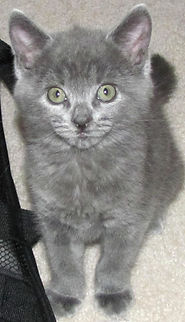
In 2010, we adopted a perfect grey kitten named Remy. He had been found alone in a backyard at 1-2 days old, with his umbilical cord still attached. He was nursed back to health by a good Samaritan and a few months later, adopted by us. He was always a finicky eater, but in mid-2015, he seemed to lose his appetite completely and started vomiting often. He was obviously losing weight, but his personality was just as bright as ever. I took him to the vet several times and his bloodwork kept coming back as perfect. I had no idea how to help him and was very concerned. By November, he was so thin and eating only treats and a calorie boosting supplement. I begged the veterinarian for help. Obviously, we needed more than blood tests. In December of 2015, a “thickening” of his stomach lining was identified via x-ray, and then confirmed by an ultrasound. The vet said it was either Inflammatory Bowel Disease (IBD) or Lymphoma, and that I should bring him in right away for a surgical consult. The next day, we saw the surgeon who did an ultrasound guided biopsy and found a lesion (mass) and took samples of the mass, stomach lining, and surrounding lymph nodes. Results did not provide a specific diagnosis; however, there was no evidence of lymphoma. Our surgeon was still concerned that it was some form of cancer, and stated that Remy needed surgery right away to survive.
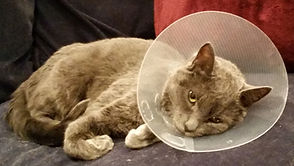
On December 19, 2015, a golf ball sized lesion located in his pylorus (the area where the stomach connects to the small intestine) was removed, along with 15% of his stomach, some small intestine and two lymph nodes. When he came home two days later, Remy was miserable and having a tough time. I took him to the ER on December 24th because he seemed to be in pain again. They gave him more pain meds and did an ultrasound and bloodwork. The ultrasound was clear, but bloodwork showed that Remy was anemic (likely from surgery) and that he had elevated eosinophils, which are a type of white blood cell. The biopsy results came back on December 29th and indicated a very aggressive form of mast cell cancer which I was advised was very unusual in the GI tract of cats. The surgeon did not feel optimistic about Remy’s prognosis and advised that we see an oncologist right away. The next day, Remy met with the oncologist who recommended we start chemotherapy (CCNU) and steroids (prednisolone). He started both that day. The prognosis was not good, I was absolutely terrified, and Remy just wasn’t acting like himself. We asked for a second opinion on Remy’s biopsy since it was an unusual diagnosis.
The second opinion (from the same lab) came back as Feline Gastrointestinal Eosinophilic Sclerosing Fibroplasia (FGESF). The oncologist had never heard of FGESF and sent me some studies she found on it, but there were very few and mostly conducted on cats that had already passed away. There was barely any information out there, and none at all regarding long-term prognosis. All I was told was that it was a very controversial disease with “a not very good survival rate.” After the second diagnosis was made, the pathologist that originally diagnosed the mast cell tumor (MCT) adamantly disagreed. As a result, every single pathologist in the lab had a meeting to determine an official diagnosis and after both pathologists presented their cases, a consensus could not be reached. I was so scared – my baby either had a very aggressive form of cancer or a disease that no one knew anything about! Naturally I insisted on a third opinion. I said, “No more messing around, we are sending the sample to University of Pennsylvania,” which is a very well-regarded veterinary institution.
While waiting for the results, Remy was going to the oncologist every week to be weighed and have bloodwork and other tests. He was anemic and not gaining enough weight, and having trouble taking the prednisolone orally. The oncologist prescribed Cerenia, Pepcid and Mirtazapine, as well as ordering transdermal prednisolone, to reduce the stress of forcing it orally. In the meantime, the oncologist was doing research on FGESF and reaching out to many colleagues. There was just so little information out there, but after speaking with other veterinary professionals, she said she was leaning toward the FGESF diagnosis. The treatments for MCT and FGESF were different, so we decided to wait to hear the third diagnosis. After a few weeks, we finally heard back from Penn and the official diagnosis was FGESF. The Penn pathologist did not know what to recommend and was concerned because he wasn’t sure that the entire mass had been removed, citing that there were “unclean edges.” Based on this diagnosis, we decided not to move forward with the chemotherapy, but to continue with the prednisolone. According to the few studies on FGESF that existed at the time, prednisolone and antibiotics were the recommended treatment.
From that day forward, I reached out to every author of any existing FGESF studies, feline veterinary specialists, feline veterinary organizations and foundations, vet schools and teaching hospitals, surgeons, gastrointestinal specialists, and anyone else I could find. No one knew the cause of the disease, the progression of it, or how to treat it long-term, as there was no documentation of cats living long-term with it. There was virtually no research behind it and no vets in the United States had heard of it. It was then that I heard back from one incredibly lovely vet from Australia who had published the most recent FGESF research study, and was willing to help us. Over the years, Dr. Michael Linton has been an invaluable resource of veterinary advice and support for us.
At that time, I was also looking for other people whose cats were diagnosed with this illness. Over several months, I was able to find only three other folks who had cats with FGESF. Every one of them had a different experience than Remy, and every one of them had a different understanding of what the disease was and how it acted. It was just so scary. I decided to create a Facebook support group for FGESF so that no one would ever feel as alone and terrified as I did when first hearing of this extremely rare diagnosis. People should know that there is another option when they hear “IBD, Lymphoma or Cancer.” https://www.facebook.com/groups/fgesfsupport
By March 2016, Remy was back to a normal weight and was no longer anemic. Even though his FGESF was successfully managed by transdermal prednisolone, I was worried all of the time. I was monitoring him constantly and making note of any behavioral and appetite changes. Every time he vomited, or even just looked a little off to me, I panicked. My mission was to find an anti-inflammatory diet for him which I was hoping would help reduce the inflammation, thereby making the prednisolone unnecessary. We met with several holistic veterinarians and veterinary nutritionists, tried gourmet personalized diets, homemade foods, hydrolyzed foods, novel proteins, holistic tinctures, bone broths and supplements; Remy would have none of it. The only thing we did not try was a raw diet which was advised against being that his gastrointestinal system was very fragile and susceptible to infection. While there are many diet suggestions for FGESF cats, the most important food is the one they will eat willingly! My Remy ate a veterinary gastrointestinal dry food (not hydrolyzed and not novel protein) with no issues for many years.
He was seeing the oncologist every 2–3 months for a complete exam, bloodwork and ultrasound, to make sure that there had been no recurrence of FGESF and that the prednisolone was not causing any harm. During this time, we were concerned about possible long-term side effects from the steroid, so we tried many things to help wean him off of it. Every time we attempted to decrease the dosage, he started vomiting again. What we would learn later is that when treating FGESF, the goal is to find the lowest effective dose of the corticosteroid that manages the symptoms of the condition, without causing any side effects. This is very typically a successful lifelong medication for FGESF cats.
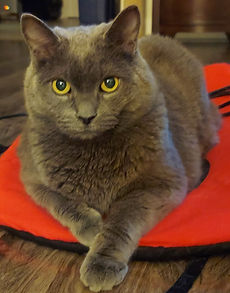
In mid 2019, Remy was diagnosed with Chronic Kidney Disease (CKD) which was unrelated to the FGESF. Since 2016, Remy had been thriving on the low dose of transdermal prednisolone, and was a perfect, chubby kitty. I cherished every single ounce of him. With proper treatment, Remy’s CKD was well-managed. Unfortunately for my sweet boy, he would develop a few other conditions over the next few years, most notably IBD, pancreatitis, a ureteral blockage, and a functional flow heart murmur. It is important to know that these conditions were all unrelated to the FGESF. When the IBD developed in 2021, we thought it was a FGESF flare-up. We temporarily increased Remy’s prednisolone, and eventually came to the conclusion that the transdermal form was no longer working for him.
Remy continued to do very well on the oral prednisolone. Even with all of the issues he had, he seemed very happy and healthy. Then in 2022, Remy was diagnosed with two very rare, very aggressive cancers (colonic and pancreatic adenocarcinomas). He had surgery in September of 2022, and had been managing well on chemo afterwards. His prognosis was grim, 3-6 months at most with chemo they said. A year later, my miracle kitty was still somehow thriving. And then, the colon cancer came back with a vengeance.
On October 17, 2023 Remy passed away in my arms. A miracle from the day he was born, he was abandoned and nursed back to health by a good Samaritan.Through years and years of more illnesses than any one perfect innocent creature should ever withstand, he was a survivor – a remarkable, magnificent being with a larger than life personality. I am convinced had it not been for these other health issues, that Remy would still be thriving on prednisolone to manage the FGESF.
Although I am devastated without Remy, I am so pleased that the Facebook group has grown significantly and now includes many FGESF cat parents, veterinary professionals, and a supportive community of animal lovers. Dr. Linton, along with other FGESF specialists, participate in this group, and have guided many cat parents and vets through the treatment process. We have learned a lot about FGESF since Remy’s diagnosis in 2016, and I am thrilled to see more and more FGESF research studies being conducted (several featuring cats from our Facebook group). Together, we have worked to spread awareness about FGESF, and provide guidance and support to pet parents and veterinary professionals on six continents.
I’d like to think that my Remy has personally helped save hundreds of cats. The outpouring of appreciation for Remy's inspiration and the group's collective efforts is something that I am beyond proud of. It is his legacy and I owe it to him to maintain and expand it. This website is the latest labor of love in preserving Remy’s legacy.
Rest in Peace Remy - my perfect baby boy, my soulmate, my best friend, my little love, my angel. I promise to do my best to make you proud until the day we can be together again. I love you more than anything in the world my beautiful baby boy, my Munchie.